



 86-539-3101518
Fax: 86-539-3101518
Mobile: +86-15969943322
+86-18853986768
Email: Jasonqiao@sdfocusmachinery.com
Factory address: No.1 Zhubao wood industry zone, Lanshan district, Linyi-276000, Shandong,China.
Office: F16, Amethyst mansion, Linyi, Shandong,China.

 Jasonqiao@sdfocusmachinery.com
Product Details
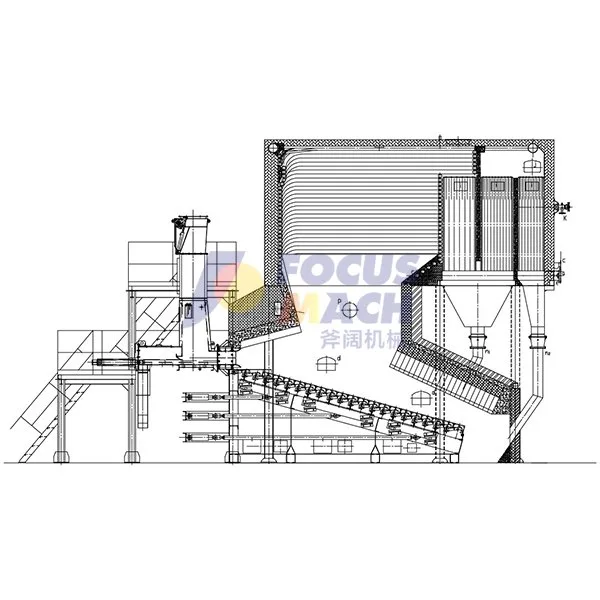
The YLW series biomass-fired organic heat carrier boiler is a modular, forced-circulation unit featuring a chain grate (or reciprocating grate). The boiler consists of an upper assembly and a lower grate section, which are assembled on-site. The design is compact, requiring a small footprint; it offers a high degree of pre-assembly, a short installation cycle, and low installation costs.
The radiant heating surface of the boiler body utilizes either a single-furnace configuration or tightly packed double-helical coils, complemented by a serpentine convective heat exchanger.
To accommodate specific fuel characteristics, the design incorporates anti-dust features that minimize fouling and simplify cleaning. The convective heat exchange section employs a staggered, wide-spaced tube arrangement and includes an integrated ash-cleaning system (soot blower) to prevent ash accumulation and maintain high thermal efficiency.
Compared to traditional coal-fired boilers, this unit features a larger combustion chamber to better handle the high volatile content typical of biomass fuels.
The combustion chamber is enlarged and equipped with a secondary air supply system; the grate area is divided into distinct air zones with independently adjustable airflow, and the grate speed can be steplessly regulated.
The grate is constructed from high-temperature-resistant materials and features an optimized air-cooling design, ensuring reliable operation and a long service life.
The fuel-feeding system is protected by independent intellectual property rights and utilizes a specialized material-locking mechanism.
Both the radiant and convective heat exchange surfaces are designed with specific anti-wear features. The boiler utilizes high-quality thermal insulation materials and a specialized design that ensures excellent thermal insulation performance.
Connecting the boiler’s heating surface tubes requires fully automated gas-shielded welding technology, along with equipment capable of performing 100% real-time, in-line X-ray inspection. This ensures consistent and reliable weld quality.
Performance Advantage
1. High Efficiency and Energy Conservation
The radiant heat exchange section of the furnace features a dual-density helical coil structure, while the convective heat exchange section utilizes an S-type multi-pass design.
The tail end is equipped with an air preheater, a waste heat recovery steam boiler, or a hot water economizer—tailored to the user’s specific waste heat recovery requirements—to lower exhaust gas temperatures, boost boiler efficiency, reduce fuel consumption, and conserve energy.
The boiler incorporates high-quality thermal insulation materials and specialized construction techniques, resulting in minimal heat loss, low exhaust gas temperatures, and high thermal efficiency.
The grate-based combustion chamber is elevated and includes a secondary air supply system, ensuring uniform, complete fuel combustion and high combustion efficiency.
The unique design of the grate and furnace arch—with the grate divided into distinct air zones that allow for independent airflow regulation—enables the system to accommodate a wide range of fuel types.
The convective heat exchange section at the tail end features a specialized design and is equipped with a soot-blowing system, which prevents ash accumulation during operation and maintains high heat exchange efficiency.
The heating surfaces are optimally and logically arranged, allowing for rapid boiler startup and providing a substantial load margin.
2. Safety and Reliability
The radiant heating surface consists of a tightly packed coil, with the heating surfaces positioned to effectively reduce the thermal load on the tube walls, ensuring safer operation when using a liquid heat-transfer medium.
The flow rate of the medium is well-regulated; the heat-transfer fluid transitions from a lower velocity at the inlet to a higher velocity at the outlet. The intermediate gases generated during operation are difficult to contain within the furnace and can be easily removed from the system.
The feeding device employs a material-locking mechanism to distribute secondary air to the incoming fuel; this effectively prevents flame flashback and protects the hopper from damage.
The boiler system supports both remote and on-site monitoring, featuring a comprehensive suite of automatic control and instrumentation tools that ensure safety, reliability, and ease of operation. By integrating industrial automation, Internet technologies, computer software, and artificial intelligence, an IoT platform for industrial boilers can be established—enabling remote human-machine interaction, data exchange, and automated control.
3. Environmental Protection: In compliance with local environmental regulations, the system must be equipped with appropriate flue-gas cleaning equipment, ensuring that all flue-gas emissions meet established environmental protection standards.