



 86-539-3101518
Fax: 86-539-3101518
Mobile: +86-15969943322
+86-18853986768
Email: Jasonqiao@sdfocusmachinery.com
Factory address: No.1 Zhubao wood industry zone, Lanshan district, Linyi-276000, Shandong,China.
Office: F16, Amethyst mansion, Linyi, Shandong,China.
Time: 2026-10-19 16:40
Description:

 Jasonqiao@sdfocusmachinery.com
Product Details
Brief Guide to OSB/PB Production
Overview of the Manufacturing Process
1 · Flake Preparation Section
Raw wood material is delivered to the factory and sorted by species.
Option 1:
Wood logs, offcuts, and other short pieces are fed via a conveyor belt into a drum chipper. The resulting wood chips are transported—via a discharge conveyor and a bucket elevator—to a storage silo. These chips are then processed into high-quality flakes using a ring-type flaker and pneumatically conveyed to a wet flake silo.
Option 2:
Raw wood is fed via a conveyor into a long-log flaker, where it is processed directly into high-quality flakes in a single pass. The flakes are then pneumatically conveyed to a wet flake silo.
Option 3:
Long logs (such as small-diameter timber) are fed via a conveyor into a long-log flaker and processed directly into high-quality flakes, which are then pneumatically conveyed to a wet flake silo. Alternatively, wood offcuts and other short materials are fed into a drum chipper; the resulting chips are pneumatically transported to an intermediate storage silo, then processed into high-quality flakes using a ring-type flaker, and finally pneumatically conveyed to a wet flake silo. 2 · Drying and Screening Section
Wood chips (shavings) exiting the wet-material silo are transported via a screw conveyor into a rotary dryer. Once dried, the material is moved by another screw conveyor to a screening machine. The dryer’s discharge screw conveyor is equipped with a spark detection system; if a spark is detected, the dry material can be automatically diverted out of the system. Oversized chips are sent to a secondary crusher for further processing, then—along with the medium-sized chips—are transported by a screw conveyor to an air-flow classifier (sorter). Properly sized fine material is sent to the chip silo. Material that passes through the air-flow classifier is sent to a storage silo for intermediate holding. Oversized material rejected by the classifier is sent to a mill for further size reduction, then combined with the fine chips and directed to the chip silo. Depending on the required ratio of surface-layer to core-layer chips—which varies based on the thickness of the panels being produced—a portion of the coarse chips can be diverted to a refining machine (grinder) to be processed into surface-layer material.
3 · Gluing Section
This section encompasses the preparation and delivery of paraffin emulsion and hardener solutions, the storage of additives, and the system for preparing and applying the adhesive mixture. Adhesive blends for the surface and core layers are prepared in a centralized glue-mixing unit. The entire adhesive preparation and application process is managed by a PLC-based control system. Automatic measurement, continuous proportioning, quantitative application, and adjustment can be implemented in accordance with process specifications.
4 · Sizing Section
Wood chips and adhesive are handled separately. Wood chips are metered out from a silo, passed through a vibrating feeder, and continuously weighed by a dosing device before being fed at a controlled rate into a ring-type adhesive mixer. The mixer thoroughly blends the wood chips with the atomized adhesive, ensuring uniform coating. The amount of adhesive applied is automatically adjusted in response to fluctuations in the wood chip feed rate, thereby maintaining a constant resin-to-wood ratio as defined by the process requirements.
5 · Hot-Pressing Section
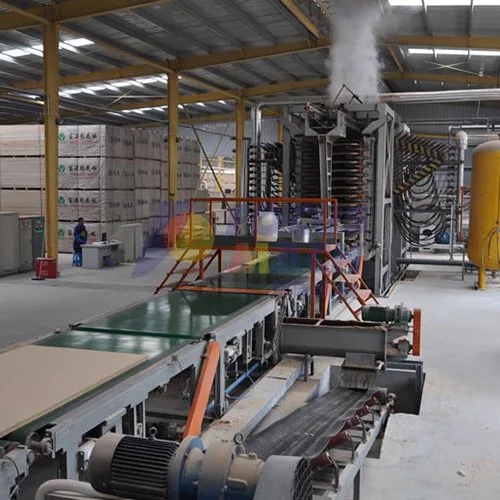
After the adhesive is applied, the surface and core wood chips are transported via a belt conveyor to a mobile pneumatic forming station. Two sets of opposing air-jet nozzles distribute the chips. On the mesh belt of the forming conveyor, the material is laid down to create a particleboard structure with fine, uniform outer layers and a graded core. The formed particleboard mat is cut to the required length by a cross-cut saw, and the offcuts are returned to the forming machine via an air-conveying system. During the hot-pressing process—carried out in a single-opening hot press—the forming conveyor simultaneously moves the pressed board out of the press while feeding a new mat into it. Meanwhile, the forming machine moves rapidly in the same direction, laying down a new mat once it reaches the starting position. Any substandard boards can be sent back to the wet-material bin for recycling.
6 · Edge-Trimming and Sawing
The pressed raw board moves onto a conveyor equipped with a weighing system, where it is centered and weighed. It then enters a longitudinal and transverse sawing machine, where it is trimmed to the final dimensions. The trimmed-off material can also be returned to the wet-material bin. The finished boards are moved via a roller conveyor—passing through a centering device and a hydraulic lifting platform—onto a roller-deck staging area, from where they are transported by a forklift to an intermediate storage zone. 7 · Sanding Section
The stored boards are fed into the sanding system. The sanding system consists of a hydraulic lifting platform, a roller conveyor, a wide-belt sander, and other components. Once sanded, the finished boards undergo inspection and classification before being moved to the finished-product warehouse.
8 · Electrical Control System
The particleboard production line features a central control station that oversees the entire process—from particle metering, calibration, and forming to hot pressing and final edge-trim weighing. The line can be operated either automatically or manually, governed by a pre-programmed PLC system. Additionally, local control stations (cabinets) are installed at each operational section—with the exception of the forming and hot-pressing sections—to manage and monitor the equipment within those specific areas.